
Are you matching your AI strategy to your reality?
Cyril Bouquet shows how to improve your return on AI investment by matching your strategy to your organizational reality and selecting among four different AI innovation approaches....

Don’t accept or reject AI recommendations indiscriminately: use your intuition as a litmus test. If something doesn’t feel right, go find out why. Allow your gut feeling to trigger deeper investigation.
Teach yourself and your team to ask, “Does this explanation make sense in our context?”, rather than, “Do I like this answer?”
Intuition often manifests as hesitation or discomfort. Normalize the idea that it’s okay to question AI outputs, especially when explanations don’t feel satisfying. This avoids both blind trust and reactive dismissal.
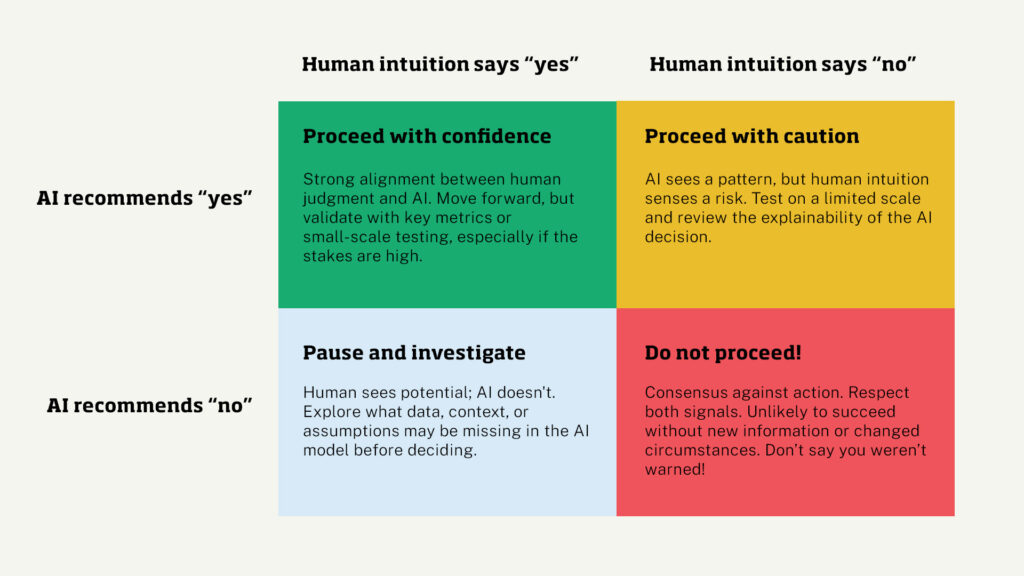
Humans often get it right when they question AI with good cause. Encourage teams to log and analyze instances where intuitive disagreement with AI led to better decisions, and build those patterns into future system design or training. The “traffic light” model below summarizes some tactics for managing situations when humans and AI agree or disagree.


Cyril Bouquet shows how to improve your return on AI investment by matching your strategy to your organizational reality and selecting among four different AI innovation approaches....

Many organizations are discovering that scaling AI is far more difficult than piloting programs. Drawing on data from the world’s largest 300 companies, the IMD AI Maturity Index reveals how the leading companies...

As AI reshapes business operations, your leadership development efforts must focus on enabling humans to continue to add distinctive value. Michael D. Watkins explains how to use the 75/25% rule to guide...

Forget everything you’ve heard about genius CEOs, intuition, and heroic decision-making, says Susanne May – use Jensen Huang’s radical leadership of Nvidia as a blueprint to succeed in the AI era....
Explore first person business intelligence from top minds curated for a global executive audience